Guide Library

Breathing Practice Guides

Step-by-step breathing patterns for every moment of the day — from a two-minute refresh to a quiet wind-down.

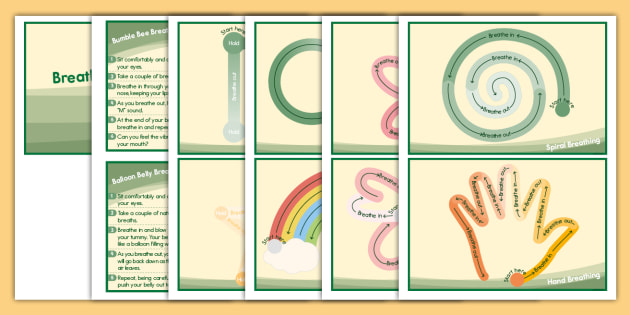
Illustrated overview of structured breathing practice cards with step-by-step guides and circular breathing patterns
Direction one

Quick Reset Breathing

Short breathing sequences for moments when attention drifts. Each practice takes two minutes or less and can be done seated, standing, or walking.

4-4 Box Breathing

2 min  ·  Any position  ·  Anytime

A symmetrical breathing pattern using equal counts for each phase. The evenness of the rhythm creates a simple anchor point for scattered attention.

  1. 1 Sit or stand with a relaxed posture. Let your shoulders settle naturally.
  2. 2 Breathe in through your nose to a slow count of 4.
  3. 3 Hold the breath gently for 4 counts — no strain.
  4. 4 Exhale fully through the nose or mouth for 4 counts.
  5. 5 Rest for 4 counts before the next inhale. Repeat 3–5 cycles.

Triple Exhale Reset

1 min  ·  Standing or seated  ·  Any transition

Three slow exhales in a row release any build-up of physical tension and allow the next inhale to arrive naturally and fully.

  1. 1 Take a comfortable natural inhale.
  2. 2 Exhale slowly and completely — let the breath go without forcing.
  3. 3 Allow the next inhale to arrive on its own. Exhale again.
  4. 4 Repeat for a third cycle. Notice the quality of the breath that follows.

5-Count Anchor

2 min  ·  Any  ·  Pre-task or mid-task

Counting each breath to 5 gives the mind a gentle object to rest on, interrupting the cycle of scattered thinking without requiring effort.

  1. 1 Begin breathing at your natural pace.
  2. 2 With each exhale, count silently: one, two, three, four, five.
  3. 3 After reaching five, begin again from one.
  4. 4 If you lose count, simply return to one — no judgment required.
  5. 5 Continue for 10–15 breath cycles.
Direction two

Focus Breathing

Breathing patterns to accompany sustained work or study. These are designed to run quietly in the background — not as exercises to perform, but as a gentle rhythm beneath activity.

Even Breath Rhythm

5–20 min  ·  Seated  ·  During work

A balanced inhale-exhale pattern with equal timing on both sides. The evenness supports a steady internal tempo that sits beneath focused activity.

  1. 1 Settle into a comfortable seated position before beginning your task.
  2. 2 Establish a 5-count inhale through the nose.
  3. 3 Exhale at the same pace — 5 counts through the nose or mouth.
  4. 4 Begin your work. Let the rhythm continue as a background quality.
  5. 5 Check in every few minutes. Return to the rhythm if it has faded.

Nasal Breathing Practice

Throughout the day  ·  Any  ·  Ongoing awareness

Simply maintaining nasal breathing during everyday activities — reading, writing, listening — is a widely used awareness habit during focused work.

  1. 1 During your next reading or writing session, gently close the mouth.
  2. 2 Allow all breathing to occur through the nose at a natural pace.
  3. 3 Notice if the breath becomes shallower or faster — gently deepen it.
  4. 4 Continue for as long as is comfortable. Pause if you feel any strain.
Direction three

Slow Calming Breathing

Longer, softer breathing patterns for transitions and pauses — moving between activities, preparing for rest, or simply taking a moment to slow down.

Extended Exhale

3–5 min  ·  Seated or lying  ·  Transitions

Using a longer exhale than inhale may feel like a slower, calmer rhythm for many people. This practice is purely informational.

  1. 1 Find a comfortable position — seated or lying down is equally suitable.
  2. 2 Breathe in through the nose for 4 counts.
  3. 3 Exhale slowly through slightly parted lips for 6–8 counts.
  4. 4 Rest briefly at the natural end of the exhale before the next breath.
  5. 5 Continue for 6–10 cycles. Adjust counts to your comfort level.

4-7-8 Rhythm

3 min  ·  Seated or lying  ·  Before rest

A longer hold and extended exhale pattern. This breathing rhythm is a widely shared traditional breathing pattern described in many lifestyle and awareness contexts.

  1. 1 Exhale completely through the mouth to begin.
  2. 2 Inhale quietly through the nose for a count of 4.
  3. 3 Hold the breath gently for a count of 7.
  4. 4 Exhale fully through the mouth for a count of 8.
  5. 5 Repeat up to 4 cycles. Stop if you feel any discomfort.

Slow Diaphragmatic Breathing

5–10 min  ·  Lying  ·  Evening

Breathing into the lower part of the lungs using the diaphragm creates a slower, fuller breath pattern. A good practice for the end of the day.

  1. 1 Lie on your back. Place one hand on your chest, one on your belly.
  2. 2 Breathe in slowly. Allow the belly to rise while the chest stays relatively still.
  3. 3 Exhale gently. Feel the belly fall.
  4. 4 Continue without a count — simply at whatever pace feels naturally slow.
  5. 5 Practice for 5–10 minutes. Let the eyes soften or close.

Informational notice

All materials and practices presented here are educational and informational in nature and are intended to support general well-being. They do not constitute medical diagnosis, treatment, or recommendation. Before applying any practice, especially if you have chronic conditions, consult a qualified medical professional.